
Atlas editions / Monograph 05
Beyond the West-to-East Spine
Fantasy Maps as Working Constraints, With a Counterexample
4 min read
Begin readingMonographs05
The argument
Tolkien’s working maps and Le Guin’s Earthsea maps offer different spatial constraints without supporting a universal theory of continental conquest or island equilibrium. This essay compares identified archival versions, follows a constructed journey across two layouts, and asks where geography permits rather than dictates a narrative.
In this monograph
01Which map?
A fantasy map is often treated as a compact explanation of its story. That is tempting because a line can look like a destiny: west to east, coast to fortress, home to danger. But we need to identify the map before we infer the grammar. A working sketch, a printed endpaper and a later commemorative reproduction can perform different jobs.
The Tolkien Estate identifies a north-west Middle-earth working map around 1948 and its companion map of Rohan, Gondor and Mordor, used to plot Book 5. It also describes a 1940s Mordor view whose relative positions changed as the story developed. These records support the narrower claim that mapping participated in composition. They do not prove that every journey was perfectly synchronized or that every later fantasy author inherited one spatial ideology.
The Le Guin archive identifies her Earthsea map as an author-created archipelago. It distinguishes the map drawn before A Wizard of Earthsea from later tracings of early editions, in black ink and in color; the 2023 print reproduction is another publication object. My comparison concerns those documented working and reproduced versions, not an imagined single map that never changed.
Terrain gives a journey its shape
Departure A familiar point of origin.
Constraint A pass concentrates movement.
Destination The route gives distance narrative weight.
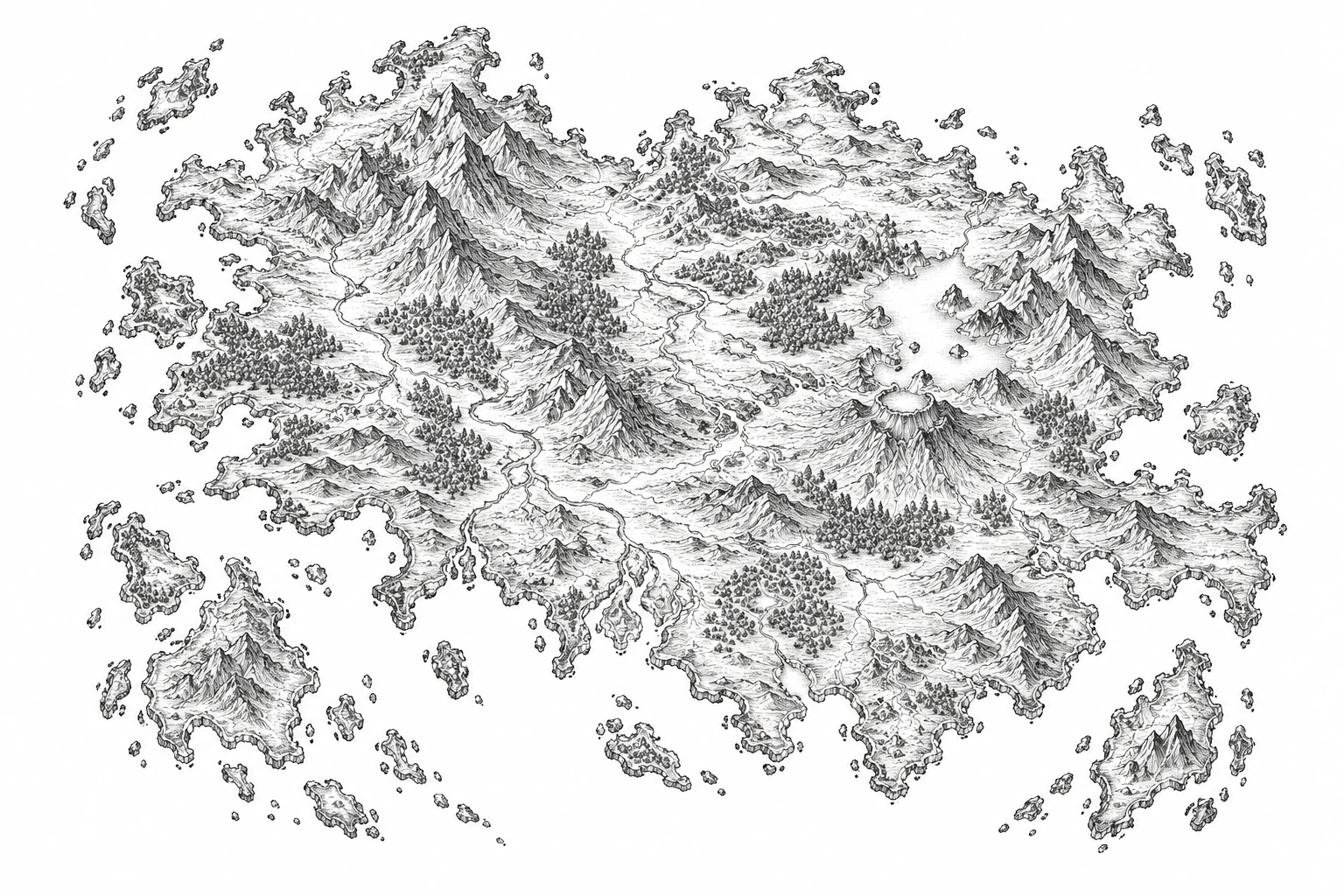
An invented journey moves from a settlement through a mountain pass toward a distant destination. Obstacles structure the route. This is an interpretive diagram, not a map of Middle-earth.
Tolkien Estate · author maps ↗02What a journey can ask of space
Take a constructed story: a courier must carry a document from Home to Archive, then return with a witness. In layout A, the route crosses a continuous region separated by a mountain barrier and a guarded pass. In layout B, it crosses two channels between three islands. These are invented layouts, not reconstructions of a specific Tolkien or Le Guin itinerary.
The pass creates one kind of dependency: permission, climbing ability or an alternate crossing. The channels create another: a vessel, weather and somebody willing to sail it. Those constraints can shape encounters and delay. Neither layout tells us what the courier values, who controls the crossing, or whether the ending will be conquest, negotiation or refusal.
This is where the simple continental-versus-archipelagic opposition fails. An archipelago can centralize power around its ports and shipping lanes. A continent can contain many overlapping communities and circular journeys. Geography changes possible relations; political organization and narrative choice decide how those relations are used. That counterexample is logical, not a historical claim about every island state.
A sea of possible connections
Many centers Several places can anchor a journey.
Relationships Routes connect rather than divide.
Return The path can form a circuit.
An invented island network replaces a single directional route with several connections and a return path. It visualizes the essay’s reading of archipelagic worldbuilding without reproducing Earthsea geography.
Ursula K. Le Guin Literary Trust · author maps ↗03Constraint without destiny
A worldbuilder can use the two layouts as a revision instrument. First write down the travel constraint and the source of help. Then change one crossing while keeping the courier’s purpose fixed. Does a scene disappear? Does another person become necessary? Does the return route alter what the courier knows? Those changes expose the map’s participation without reducing the characters to geography.
The documented Tolkien revisions are especially useful against the idea of a map as an immutable template. A writer can redraw the spatial relation as the narrative develops. The consistency a reader experiences is an editorial achievement, not evidence that the earliest drawing already contained every event.
For an interactive game, I would need an additional account of what the player can see, traverse and remember. A drawn route alone cannot establish the experience of verticality or the timing of discovery. The former broad promise about FromSoftware is therefore withdrawn from this essay; no game build, traversal capture or player study is presented here.
The proposed test is modest: compare versions, follow one declared journey, state the dependencies each layout creates, and look for a counterexample to the interpretation. A claim about an author’s intention needs that author’s own evidence. A claim about how readers respond needs readers. Close attention to a map supplies neither automatically.
Going beyond the west-to-east spine means giving spatial form a specific job in an argument. A map can offer a route, a boundary, a missing connection or a revision opportunity. Its power comes from the consequences somebody makes of those possibilities. The essay should preserve that agency rather than turn a continent or an ocean into a moral verdict.
Publication details
The colophon
- Author
- Evelyna Bellamy
- Published
- July 12, 2026
- Revision
- 2026-10-11
- Edition
- Cartologium · Online edition
- Length
- 687 words · 4 min read
Bellamy, E. (2026, July 12). Beyond the West-to-East Spine. Cartologium. https://cartologium.com/monographs/beyond-the-west-to-east-spine
Further reading / APA 7th edition
Sources & citations
- 01
The Tolkien Estate. (n.d.). Maps [Archival maps and descriptive catalogue]. Retrieved October 11, 2026, from https://www.tolkienestate.com/painting/maps/
Primary estate catalogue distinguishes working maps around 1948, the Book 5 map and revised Mordor positions. No copyrighted map is reproduced here.
- 02
Ursula K. Le Guin Literary Trust. (n.d.). Maps of Earthsea [Author maps and publication history]. Retrieved October 11, 2026, from https://www.ursulakleguin.com/maps-of-earthsea
Primary literary archive distinguishes the original drawing, later tracings and print reproduction. The courier comparison is constructed.
View original reference plate